
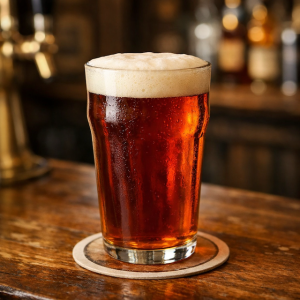
Amber Lager is one of the most quietly misunderstood styles in the modern beer world. It lacks the dramatic origin story of Pilsner or the seasonal mythology of Märzen, yet it persists—often mislabeled, frequently overlooked, and regularly misunderstood. It also lacks a bodacious hop inclusion or a Richter scale rattling ABV. Its understated nature fails to attract those looking for the loudest voices in the crowd.
What makes Amber Lager difficult to define is also what makes it essential: it occupies the middle ground between styles without surrendering its identity.
Building the Perfect Amber Lager
Broadly speaking, Amber Lagers fall between several familiar landmarks. They are lighter in body and richness than Vienna Lager or Märzen, yet darker and more malt-driven than a Dortmunder Export. Imagining the flavor area between these two classic lagers is enough to get your mouth watering. Where Vienna leans heavily on elegant toasted malt, and Märzen embraces depth and fullness, Amber Lager pulls back just enough to remain highly drinkable. It is not designed to impress through intensity, but through balance.
One of the most telling distinctions between Amber Lager and Vienna Lager often lies in the selection and proportion of hops. Vienna traditionally emphasizes malt expression with restrained bitterness, while Amber Lager frequently introduces a slightly firmer hop presence to sharpen the finish and keep sweetness in check. A side-by-side comparison of brewhouse formulations—particularly when both styles are produced by the same brewery—often reveals similar alcohol levels and color, but a noticeable divergence in bitterness, attenuation, and final balance. In practice, Amber Lager tends to finish drier and cleaner, with hops playing a subtle but critical supporting role.
From a technical standpoint, Amber Lager is a revealing style. It offers little room to hide flaws. Seeking out styles like Amber Lager and Irish Red Ale is the perfect way to test the mettle of any brewery/brewer you encounter. Excessive crystal malt can quickly tip it into cloying sweetness, while insufficient hop structure leaves it dull and flabby. Push it too far in either direction, and it risks becoming something else entirely—a red ale fermented cold, or a thinned-out Märzen lacking body and structure.
The choice of hops is vital. We love seeing Hallertau Mittelfrüh, Tettnang, and Pearl being used, while Cascade or Chinook will set off our radar. Often, US, west coast-style Amber Lagers are so heavily hopped that they are not much more than an IPA in a lager suit. Brewing a great Amber Lager requires restraint, precision, and a keen attention to detail.
When executed well, Amber Lager delivers gentle toasted and bready malt notes, restrained caramel character, and a clean lager finish that invites another sip. It is a beer designed for repeated enjoyment rather than contemplation, prioritizing balance over bravado. In that sense, Amber Lager is a brewer’s discipline beer—subtle, composed, and quietly confident.
Classic and contemporary examples vary by region and interpretation, but well-made Amber Lagers can be found among German-influenced American craft brewers and select European producers that value drinkability as much as flavor. Though it rarely commands headlines, Amber Lager remains a vital style for those who appreciate nuance, balance, and the understated art of restraint. Search your favorite brewpub for an example of this classic brew.
Great examples include Yuengling Lager (USA), Great Lakes Brewing Eliot Ness (USA), Abita Brewing Amber (USA), and Brooklyn Brewery Lager (USA).
Back to Beer Styles
Subscribe and never miss any of our new content, and get enrolled as a BevX insider for free.
Do you want to better understand beer? May we suggest Be A Beverage Expert (BABE), a guide to understanding wine, beer, spirits, and cocktails.