

Cognac is the world’s most famous grape Brandy, poured in nearly every drinking country on earth — and it exists in the first place because of a shipping problem. In the sixteenth century, Dutch traders came to the Charente for salt, paper, and wine, and found the local white wine too thin and too fragile to survive the voyage home. Their fix was to distill it down into something more stable and less bulky to transport: brandewijn, “burnt wine,” a term English eventually wore down into Brandy. What began as a practical shortcut turned into a discovery. Casks of the stuff, left waiting in Limousin oak for the next ship out, came back darker, smoother, and better than they went in. By the early seventeenth century, distillers were running the spirit through the still a second time, and something recognizably like modern Cognac existed for the first time. If it reminds you of the IPA story, you’re an astute beverage expert.
The house of Augier opened its doors in 1643, the first Cognac house on record, and a century later the founding rush was on: Martell in 1715, Rémy Martin in 1724, Hennessy in 1765 — founded, in a detail I take a little personal pride in, by an Irish soldier named Richard Hennessy who’d been fighting for the French crown and decided brandy paid better than war. Courvoisier traces back further still, to a Paris wine-trading house from 1796, but didn’t become a Cognac producer in its own right until the family relocated the operation to Jarnac in 1828.
The good times nearly ended for good in 1875, when phylloxera tore through the Charente and reduced the region’s vineyards from roughly 282,000 hectares to barely 42,000. Growers eventually replanted on phylloxera-resistant American rootstock, leaning hard into Ugni Blanc (aka Trebbiano) — the same grape that still accounts for more than 98 percent of the vineyard today. The modern legal architecture came together not long after: the production zone was formally delimited in 1909, Cognac earned Appellation d’Origine Contrôlée status in 1936, the six crus were carved out in 1938, and the Bureau National Interprofessionnel du Cognac (BNIC) was established in 1946 to police all of it. More than 97 percent of what’s made today leaves the country, sold into nearly 160 export markets — proof that a shipping problem, solved four centuries ago, became the most successful export story in Brandy.
Cognac — What’s in the Bottle
Cognac is made in a tightly defined AOC around the town of Cognac, north of Bordeaux, along the Charente. Allowed grapes are Ugni Blanc, Colombard, Folle Blanche, Montils, Sémillon, and Folignan (the last no more than 10% of a blend). Ugni Blanc is king: more than 98% of the vineyard. High acid, low sugar, modest alcohol. The base wines sit around 7–9% ABV. That would make a thin table wine. It is exactly what the still wants.
That still work happens twice, in copper pot stills — column stills are not permitted. The first pass, called the brouillis, yields a cloudy spirit around 28–30% ABV. The second, the bonne chauffe, is where the real skill shows up: the distiller has to cut away the volatile “heads” and the heavy “tails” and keep only the heart of the run, which comes off around 70% ABV. Distillation has to start on the first of November and finish by the last day of March; the aging clock on any given batch doesn’t start until April 1. From there it’s two years to fifty years — and well beyond — in French oak before bottling.
There are a few hundred producers. Most of the volume still belongs to the Big Four: Courvoisier, Hennessy, Martell, and Rémy Martin. Many houses own few or no vines and do not distill. Growers and small distillers deliver young eau-de-vie. The houses age, blend, and bottle. The system is old, symbiotic, and efficient.
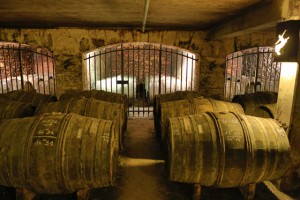
One more thing worth knowing before you visit: every year, roughly two percent of everything resting in a Cognac cellar evaporates straight into the air — la part des anges, or the angels’ share. Multiply that across the region, and it’s millions of bottles a year gone before anyone gets to pour them. It also feeds a real fungus, Baudoinia compniacensis, first identified in the Charente and named for it, that blackens the stone and rooftops of aging warehouses across the region. It’s harmless. It’s also the closest thing Cognac has to a visible fingerprint.
Among France’s three great Brandies — Cognac, Armagnac, and Calvados — Cognac leads in sales and name recognition. Reach for Cognac when you want polish and lift. Reach for Armagnac when you want more muscle and raw exuberance. Keep both.
Cognac Aging Grades
Age on the label is the youngest eau-de-vie in the blend, not the average.
- VS (Very Special, Three Stars) — youngest component at least two years in cask.
- VSOP (Very Superior Old Pale) — at least four years. Most serious VSOPs are older than the legal floor.
- Napoléon / Vieux — at least six years. After the 2018 rule change, this is the slot between VSOP and XO.
- XO (Extra Old) — at least ten years, raised from six in 2018. Many XOs carry far older stock.
- XXO (Extra Extra Old) — at least fourteen years.
- Hors d’âge — legally aligned with XO, but in practice, a house’s oldest, often well past XXO.
The Cognac Crus
The Cognac region splits into six officially designated crus — literally “growths” — each defined by its own soil and microclimate. Those familiar with the great wines from neighboring Bordeaux are well familiar with the cru moniker.
- Grande Champagne — about 13,000 hectares of compact clay-chalk around Segonzac. Slow-maturing, floral, long-lived. Premier Cru du Cognac. The most expensive eaux-de-vie.
- Petite Champagne — about 15,000–16,000 hectares. Similar chalk, a touch more clay. Lighter and a little faster than Grande. Vineyards wrap Grande Champagne to the southwest and southeast.
- Borderies — the smallest cru, about 4,000 hectares on the plateau northwest of Cognac, around Burie. Clay and flint. Round, nutty, violet-scented. Distinctive in a blend and worth seeking as a single cru.
- Fins Bois — the workhorse, roughly 31,000–34,000 hectares, ringing the inner crus. Faster-maturing, fruit-forward, lightly floral, with a faint maritime note. The backbone of a great deal of VS and VSOP.
- Bons Bois — outer ring, often cited around 9,000–16,000 hectares, depending on how the figures are drawn. Less chalk, more mixed soils. Bolder, earthier, a hint of salt. Useful blending structure.
- Bois Ordinaires — the coastal fringe. Sandy, Atlantic-influenced, the least prestigious of the six. Small commercial role.
Fine Champagne is not a cru, but it is a popular designation seen on Cognac labels. It blends Grande and Petite Champagne, with a minimum of 50% Grande Champagne.
That is the map. The glass is where it matters.
Do you want to better understand Cognac and Brandy? May we suggest Be A Beverage Expert (BABE), a guide to understanding wine, beer, spirits, and cocktails.