
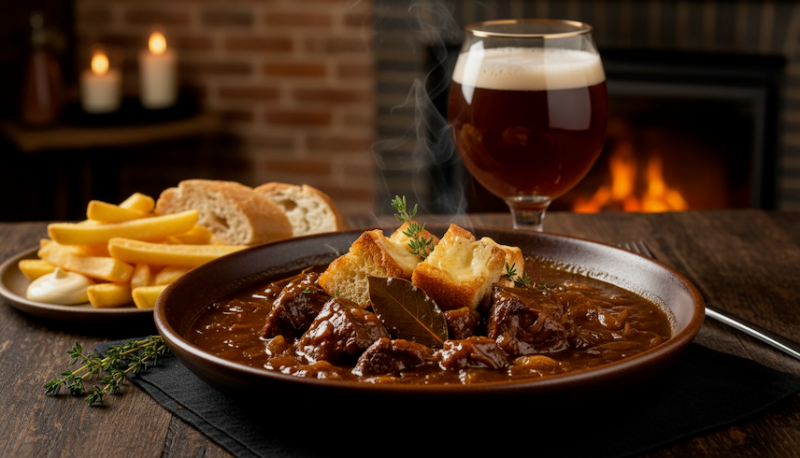
Carbonade Flamande is a classic dish found throughout Belgium. Many recipes exist, and most restaurants have their own twist on this dish. Some recipes I have seen call for marinating the beef in beer for three days. I have not found this to be necessary, but using the proper beer is a must. Look for a Flemish Brown Ale; if this is unavailable, use Dark Belgian Ale instead. Whatever you choose, don’t use an overly-hopped American Ale, as this will wreck the meal.
The term carbonade originates from the Latin word carbo, meaning charcoal, which refers to meat cooked over or near a fire. In medieval Flanders (roughly the 12th to 15th centuries), beef became more readily available due to the prosperity of cattle farming and the rise of urban butchery guilds. Tougher cuts—such as neck, shoulder, and shank—were common among working families, and slow, long cooking was the practical solution.
While wine was expensive and less accessible in northern Europe, beer was plentiful. Flanders was already a leading brewing region, so it was natural that beer replaced wine as the cooking liquid. Early versions of carbonade were probably simple beef stews simmered in local ales, flavored with onions and whatever aromatics were available.
During the 19th century, as Belgium industrialized and urban working-class culture expanded, carbonade flamande became a brasserie staple. It was inexpensive, filling, and perfectly suited to beer halls, where it could simmer for hours and be served in quantity.
This adaptive recipe is easy to do, and your friends and family will surely be pleased. Your home will be filled with the scents of braised goodness coming from your oven.
Our Recipe for Carbonade Flamande
Ingredients:
- 3 tablespoons unsalted butter
- 1 pound onions, sliced
- 2 pounds lean beef, shoulder or round, cut into 1/4-inch thick slices
- 5 Ginger Snap cookies, crushed to a fine powder
- 3 tablespoons flour
- 1 tablespoon Dijon mustard
- 2 cups Flemish Brown Ale
- 1 cup beef stock
- Salt and pepper
- 1 bay leaf
- 2 teaspoons mixed dried herbs, crumbled (thyme, rosemary, sage)
Prep and Braise Method
In a heavy pot, add butter. When the butter is hot, stir in the onions and sauté until they are caramelized. Remove the onions from the pot and set aside. If needed, add more butter and oil to the pot and begin browning the beef slices, removing them as they brown. Set aside the beef slices.
In the same pot, add enough butter or oil so that the total amount of butter or oil equals roughly three tablespoons. Add flour and whisk to incorporate well. In a few minutes, a roux will have formed. Now, stir in the mustard and crushed ginger snaps, then add the Ale slowly to deglaze the pan. Add beef stock and season with salt and pepper, and bring the mixture to a slow boil. Remove the item from the pot and set it aside.
Layer the pot with the meat and onions, creating three layers of meat and sandwiching two layers of onions in between. Add a bay leaf and a teaspoon of mixed herbs to each layer of onions. Pour the beef sauce back into the casserole. Add more Ale to cover the meat if necessary. Bring the casserole to a slow boil, cover it, and braise in a 300-degree oven for 3 hours. Skim off fat, season with salt and pepper, and serve.
Serve with a fantastic Belgian Brown Ale or perhaps a Belgian Abbey Double, accompanied by some crusty bread. Learn more about Belgian Beers here.
Thanks-a-mundo for the blog article.Much thanks again. Fantastic.