
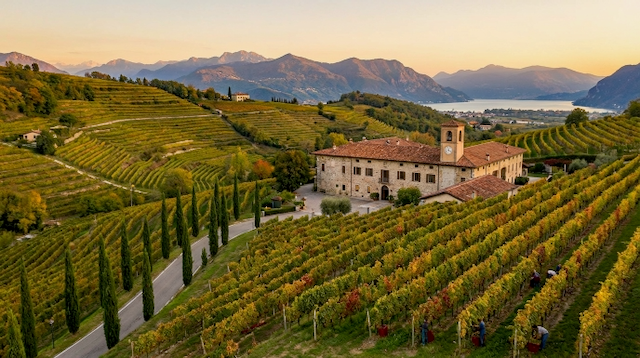
Franciacorta is a premium Italian sparkling wine appellation in the Lombardia region, located west of Milan. It is produced using the traditional method — metodo classico — with secondary fermentation in the bottle. It is sometimes called the Champagne of Italy, but that’s a lazy moniker. The production method is the same, and the grape varieties are similar, with both regions relying heavily on Chardonnay and Pinot Noir (Pinot Nero) to produce world-class sparkling wines. Both appellations sit in relatively cool growing regions — a prerequisite for top-shelf bubbly, as abundant natural acidity is essential to achieving proper balance and finesse.
Franciacorta Styles and Dosage (dry to sweet)
Franciacorta is available in several styles, some unique to the appellation and others familiar to Champagne enthusiasts.
Standard Franciacorta, simply labeled as such, is a non-vintage sparkling wine aged a minimum of 18 months on the lees. Franciacorta Rosé follows the same rules but requires at least 35% Pinot Nero. Franciacorta Millesimato is the region’s vintage wine, with at least 85% of the blend sourced from the stated vintage. Produced only in the finest years, it must age a minimum of 30 months on the lees. Franciacorta Riserva is the rarest expression — single-vintage, aged on the lees for at least 60 months, and always dry, limited to Pas Dosé and Extra Brut.
For those seeking a smoother, more delicate style, there is Franciacorta Satèn. Made primarily with Chardonnay, it is bottled at a slightly lower pressure — 4.5 to 5 atmospheres — compared to the standard 5 to 6 atmospheres (roughly 70 to 90 psi) used for other Franciacorta styles and Champagne alike. The result is a finer, creamier mousse. Satèn is aged a minimum of 24 months on the lees and is offered exclusively at Brut dosage.
Dosage refers to the addition of a specially prepared liqueur to the finished wine before final corking. Franciacorta’s dosage range closely mirrors Champagne’s, with minor differences in terminology:
Franciacorta Dosage (dry to sweet):
- Pas Dosé — Up to 3 g/l
- Extra Brut — Up to 6 g/l
- Brut — Less than 12 g/l
- Extra Dry — 12–17 g/l
- Sec or Dry — 17–32 g/l
- Demi-sec — 32–50 g/l
Franciacorta Grapes
Since its official recognition, Franciacorta has relied on three grapes: Chardonnay, Pinot Noir, and Pinot Blanc. Chardonnay dominates, accounting for nearly 75% of the vines, followed by Pinot Noir at 17% and Pinot Blanc at just 3%. In recent years, a fourth variety, Erbamat, has entered the picture. An ancient grape on the brink of extinction, Erbamat was introduced both to revive a heritage variety and to bring high-acidity insurance to the sparkling wine blend — a useful asset in warmer vintages. It may comprise up to 10% of the final wine.
Franciacorta from the Romans to Today
The Franciacorta region has been tied to viticulture since Roman times, and that connection has never really let go. Through Late Antiquity and the Middle Ages, favorable soils and climate kept vines firmly rooted in the landscape.
The name “Franciacorta” likely derives from the medieval term curtes francae, meaning “tax-free courts.” Around 1100, powerful monasteries reclaimed large tracts of land and received exemptions from customs duties. These holdings became known as francae curtes, eventually evolving into “Franzacurta” — first recorded in Brescia’s communal archives in 1277. Benedictine orders were particularly influential in spreading viticultural knowledge and establishing the region’s winemaking traditions.
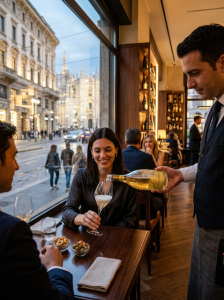
By the Renaissance, Franciacorta wines had already earned recognition beyond local tables. In 1570, the physician Girolamo Conforti published Libellus de vino mordaci — one of the earliest texts describing naturally bottle-fermented wines. Conforti called these wines mordaci, meaning lively or sparkling, and explored their sensory qualities, possible therapeutic effects, and the science of fermentation. It was a remarkably forward-thinking document for its time.
By the Napoleonic era, over a thousand hectares were already dedicated to these lively wines, and commercial sales were growing as production outpaced local demand. The modern chapter began in the early 1960s, when oenologist Franco Ziliani produced the first bottle-fermented sparkling wine from Pinot in Franciacorta, establishing the style that defines the appellation today. Franciacorta earned DOC status in 1967, and in 1995 became the first Italian bottle-fermented sparkling wine to achieve the prestigious DOCG designation. Today, the word “Franciacorta” refers at once to the region, the method, and the wine itself.
Franciacorta in the Glass
Side by side with Champagne, Franciacorta is a convincing look-alike. Most wine drinkers would be hard-pressed to identify it in a blind tasting. In general, Franciacorta tends to be a touch fruitier than Champagne — while remaining impeccably dry — offering a complex, creamy, and elegant profile with notes of citrus, toasted nuts, and brioche.
Franciacorta has less than 10% of Champagne’s vineyard area and produces a fraction of its volume. It is not going to overtake Champagne — nor does it need to. Franciacorta will remain the insider’s choice, a reward for those who know where to look. It is not inexpensive, typically starting around $30 a bottle, though it generally sells for less than a comparable Champagne. In a perfect world, your table would be graced with both. One bottle of bubbly is never enough.
Learn more about Franciacorta from the Consorzio’s website.