
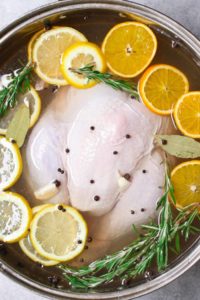
Why do we cook whole turkeys just once or twice a year? A well-cooked roast turkey is an amazing culinary treat, and it’s incredibly wine-friendly, pairing well with most white and low-tannin red wines.
Because it is an infrequent meal, our turkey-roasting skills can get rusty or vanish altogether. While there are many ways to cook a turkey and many techniques designed to better ensure success, I faithfully employ one common technique — brining.
You can brine most any protein, while poultry and most cuts of pork are incredibly well-suited to this method. (If you’re not brining your pork tenderloins — you’re doing it wrong.) The reason you brine your bird is to increase the moisture level and to ensure better success. Brining gives you a larger confluence of fully cooked and ideal moisture.
Let’s face it, cooking a turkey can be tricky and we have all been served dry, overcooked turkey. The white meat and dark meat cook at different speeds and doneness for the dark meat is achieved at a higher temperature than the white meat. Brining helps you keep the white meat juicy while the dark meat reaches the proper temperature.
When done right, brining also allows you the opportunity to inject flavor beyond salt to the bird (more on this later). You should customize your brine to best meet your taste and to better accompany the other dishes that you will be serving.
The downside to brining is that it can be difficult to find a vessel large enough to submerge the whole bird. A brining bag may offer a solution. Brine bags are now found in most groceries and on most of your favorite online stores. With a brining bag you can place the bird in the bag — in your large cooler and surround it in ice keeping it chilled and safe.
Don’t Make These Mistakes with Your Brine
Too salty — Overly salted food is never a good thing, and an under-salted brine won’t achieve the desired effect. There are hundreds of recipes available, and it’s hard to know which one is best for your taste. Through a lot of trial and error, I discovered the ideal salt-to-water ratio. To achieve this perfect ratio, you have to weigh your salt. Each variety of salt has a different density, so using a volume measurement (like cups) is the wrong way to go. I have found that the perfect ratio is 10 ounces of salt per gallon of liquid.
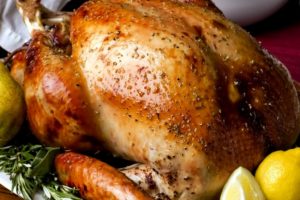
Another problem found in brining is a soggy, pale turkey skin despite the turkey being perfectly cooked internally. All experienced cooks know that a wet exterior makes it nearly impossible to achieve browning. Everyone wants a beautifully browned skin that visually excites when the turkey is brought to the table. Also, we love flavors delivered by perfectly roasted poultry skin, with its crispy exterior and remnants of slow-rendered fat underneath. To avoid a soggy turkey skin, remove your bird from the brine at least four hours before roasting — 24 hours is better. Dry the exterior, then return it to the refrigerator. Dry the turkey’s exterior again just before roasting.
A great roasted turkey with gravy is adored so be sure to have some unsalted (or low salt) turkey or chicken stock on hand to dispute the salty turkey juice that escapes the bird while roasting. The addition of wine and dairy like half & half to the gravy will also balance out the salty drippings. The combination of drippings, stock, wine, and dairy make the perfect gravy ready to be thickened by a roux or the starch of your choice.
Last but not least — be sure to give time to thawing your turkey (most of us will be buying a frozen bird). The slow, refrigerator method is best but a 15-pound turkey will take two days minimum to thaw. Give yourself time to properly thaw the bird, followed by 24 hours in the brine and 24 hours to dry out of the brine. Altogether, you could have spent the better part of the week with the bird.
Additions to your brine recipe:
Quality salt
Any fresh herbs
Any spice, including baking spices
Fresh citrus fruits
Fruit juices
Sugar — of your choice, including honey
garlic
ginger
chillies
My favorite turkey brine (recipe is per gallon of liquid)
3 quarts of water
1 quart of apple juice
10 ounces of sea salt
5 ounces of brown sugar
1 orange cut in 1/4 inch slices
2 tablespoons of dried juniper berries
1 tablespoon of brown mustard seed
1 tablespoon of whole black peppercorns
1 inch of ginger root peeled and sliced into coins
10 large fresh sage leaves
10 stems of fresh thyme
3 whole bay leaves
1 whole Chili de Arbol
Place all dry ingredients in a bowl and top with one quart of the water for this recipe at a near boil. Stir until the salt and sugar have fully dissolved, and then add the remaining liquid. Cool completely before adding the bird.
Do keep in mind that brining a turkey significantly increases the bird’s moisture, which will reduce the cooking time by about 30 minutes on average. Not often do we get superior quality with less time committed — bringing is your path to becoming a holiday superstar. Just don’t skimp on the wine — for the cook, not necessarily the turkey.
Before you put your bird in the oven, consider what to serve with the meal. See our feature on Serving Beverages at Thanksgiving that applies to serving turkey year-round.