
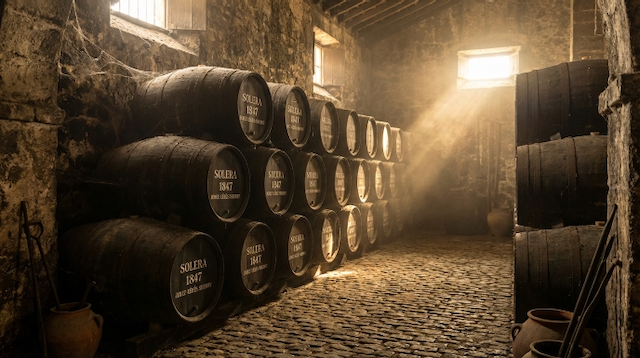
When you read about Sherry and Brandy de Jerez, you will undoubtedly encounter the term solera. Increasingly, we are also seeing solera on the labels of other spirits, such as Rum. We will breakdown the solera process explaining the concept of fractional blending in simple terms.
A solera is a special aging method that combines younger wines or spirits with older ones to keep a consistent and perfectly mature “house” style from year to year. It’s called fractional blending and is an ideal way to ensure a consistent product each year. This process also produces a product that uniquely combines qualities of older, aged liquids with new, fresh liquid, resulting in a balanced final product.
The solera process originated in Spain’s Jerez region. The first written record of the solera dates back to the mid-1800s, but the process is likely much older. It is certain that the solera technique is closely linked to its place of origin, as modern Sherry and Brandy de Jerez producers rely on it to create their signature products.
The concept of the solera has migrated beyond Jerez, Spain, to be employed by Rum producers in the Caribbean and elsewhere, Whiskey producers in Ireland, Scotland, and the USA, Vermouth makers, vinegar makers everywhere (particularly with Balsamic Vinegar), and even to create non-vintage Champagne and other classic-method sparkling wines.
How the Solera Process Works (step by step)
To understand the solera system, imagine multiple rows of casks stacked one on top of another. In Jerez, Spain, these rows or tiers are called “scales” or “criaderas.” It doesn’t have to be a stacked set of casks. Sometimes it’s just a row of casks lined up in a queue, but stacking is the traditional method. There must be at least three tiers, although most solera systems have four to six tiers.
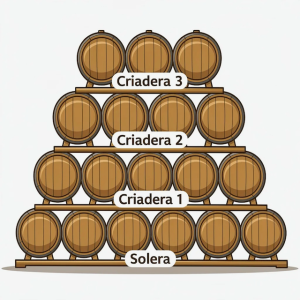
The bottom row, or criaderas, contains wine (or spirits), often called solera is the tier to be bottled. The tier directly above the solera tier is referred to as the first criaderas, the next ascending tier is the second criaderas, and so on.
When the wine or spirit is drawn from the bottom casks, only a portion (typically one-quarter or one-third) is extracted. The cask is then topped with wine from the tier immediately above it, which is topped with wine from the tier above it, and so on throughout the stack of casks. The top tier of casks is then refreshed with new wine or spirit.
No cask is ever fully emptied in a working solera system. For this reason, some products display the year their solera system was established. There are solera systems in use today that were started hundreds of years ago. This does not mean that a portion of the product in the modern solera is traceable to its origin; it is likely decades old.
Calculating a product’s age from a solera is tricky. The standard method for approximating age uses a formula that starts with the number of tiers minus the top tier, then divides by the transfer fraction (the fraction of the cask transferred downthrough the system). It’s a bit tricky, but a fraction of mystery is part of the lore. Of course, we could further complicate the calculations by considering the “angles share”, the amount of product lost to the air via evaporation.
The casks are often referred to as the solera, but Sherry and Brandy de Jerez producers refer only to the bottom or oldest row as the solera.
The Rules of Solera
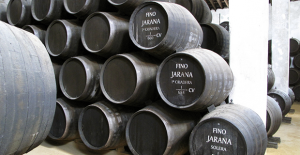
While the inventors of the solera system follow a set of legally defined rules, the rest of the world might use the term more loosely. Sherry producers are regulated by Spain’s DO system, which defines types, appellations, and processes. The DO Jerez-Xérs-Sherry states that no more than 40% of the solera system’s total volume can be extracted each year. Similar rules apply to Brandy de Jerez. A quick look at the methods for aging Sherry can be here in this external link.
In other parts of the world, standards vary, and in some cases, they don’t exist. As always, caveat emptor (buyer beware). A little research can often reveal the practices of a specific producer. If they follow a genuine solera system, they will be eager to share their practices and methods.
Tell us about your favorite solera made products.
I was pretty pleased to uncover this page. I need to to thank you
for your time for this wonderful read!! I definitely liked every little bit of it and I have
you saved as a favorite to look at new information on your web
site.